 Fenestration
 Local Builders
 Builders' Merchants
 Architects & Specifiers
 House Builders
 Main Contractors
 Lead Generation
 Direct Marketing
 Marketing Reports
 Salestracker CRM
 STEM Email Marketing
 Mobile CRM
 Software Features
 Market Overview
 FAQs
FAQs Downloads
 GDPR
GDPR Our History
 Company News
 Careers
 Book a Demo
 Contact Us
Insight Introduces Credit Alerts to Financial Data and Credit Monitoring

Credit profiling in sales has not always been part of the early decision-making process. When this content was first published in March 2016, most sales teams still followed a familiar pattern.
Prospect first.
Sell second.
Credit check last.
At the time, that approach felt normal. Credit checks were treated as a finance task, handled late in the process once time and cost had already been committed.
What selling looked like in 2016
In 2016, sales teams worked largely from static data. Lists were bought, spreadsheets were shared, and CRM systems acted as record-keeping tools rather than decision platforms.
Credit checks existed, but they were:
- Manual
- One-off
- Finance-led
- Difficult for non-financial teams to interpret
The result was predictable. Sales time was spent chasing prospects that were never financially viable. Finance teams were asked to intervene late. Bad debt was treated as an unfortunate outcome rather than a preventable risk. That was the problem we were trying to solve at the time.
Why did leaving credit checks until the end not work?
From what I saw internally and across the market, the issue was not a lack of data. It was timing.
When credit checks happen after:
- Multiple sales calls
- Site visits
- Quotes and revisions
- Internal approvals
The cost is already sunk.
Sales teams lose time. Operations lose confidence. Finance inherits risk rather than preventing it.
The earlier the insight arrives, the better the decision that follows. That principle shaped everything that came next.
Bringing credit visibility into the sales process
The original idea behind early credit profiling was simple.
Give sales teams a clear financial snapshot before momentum builds.
Not a dense report.
Not finance-only language.
But something practical, readable, and usable in real conversations.
That shift changed how sales teams qualified opportunities. Instead of asking “Can we close this?”, they began asking “Should we pursue this at all?” That distinction matters more than most businesses admit.
When credit profiling stopped being just a finance tool
Over time, it became clear that the biggest value came when credit data supported prioritisation.
Sales teams used it to:
- Focus on stable businesses
- Pause engagement where risk increased
- Protect time as well as cash flow
Finance teams gained fewer surprises. Commercial decisions became calmer and more deliberate. Credit profiling moved from the back of the process to the front.
From one-off checks to ongoing visibility
One of the biggest changes since 2016 has been the move away from static checks. Risk rarely appears overnight. It develops. That is why alerts became more important than reports. Being notified when a prospect’s financial position changes allows teams to reassess before problems surface.
In practice, that means:
- Avoiding last-minute shocks
- Reducing exposure mid-pipeline
- Making informed decisions without manual monitoring
It is a quieter form of risk management, but a far more effective one.
How Salestracker evolved with the market
As sales behaviour changed, CRM expectations changed with it. Rather than acting as a contact database, Salestracker developed into a platform that supports decisions as they happen.
Sales teams now work with:
- Live prospect data across construction and fenestration
- Financial indicators alongside sales activity
- Clear signals that guide follow-up and prioritisation
- Visibility of over 60,000 live industry prospects
That matters because sales do not happen in isolation. It happens in context.
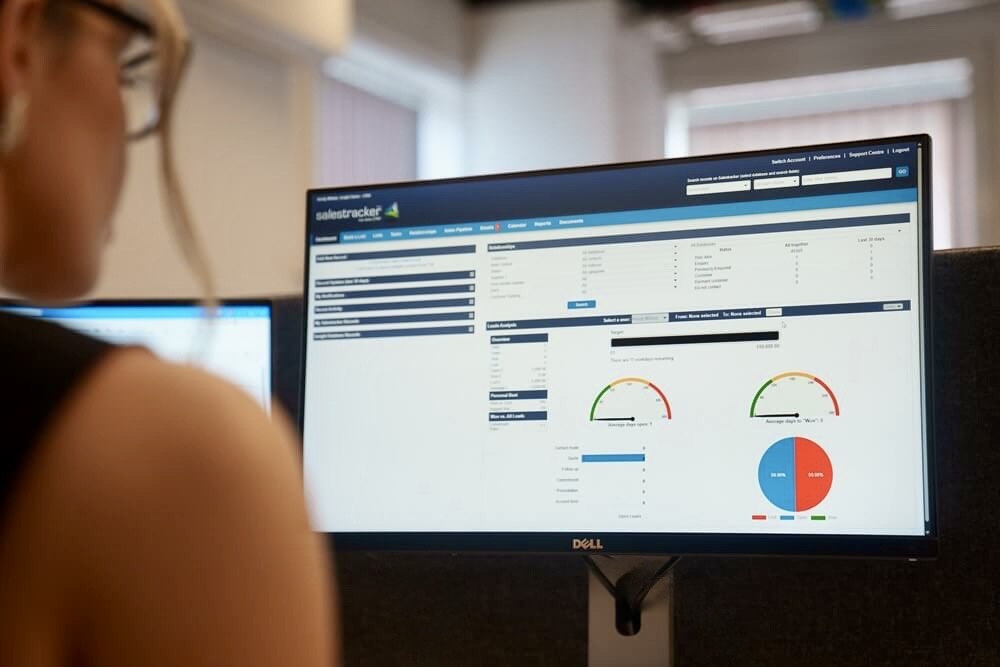
Live CRM dashboard view in Salestracker showing lead conversion rates, performance dials, and contact breakdown by status.
When sales teams can see who they are speaking to, how active they are, and whether risk is increasing or decreasing, effort is spent where it should be.
What we would not write the same way today
Looking back at the original 2016 content, it reflected how software was talked about at the time. Feature-led. Announcement-driven. Product-focused.
Today, that framing would miss the point.
We would talk less about tools and more about:
- Sales judgement
- Time protection
- Risk awareness
- Decision timing
Because that is how customers actually use the platform.
What has stayed the same over the last ten years
Despite changes in technology, some fundamentals remain constant.
Selling to unstable businesses still carries risk.
Late-stage credit checks still cost time and money.
Visibility still matters most when it arrives early.
What has changed is how naturally that insight now fits into everyday sales activity.
What ten years in the market teaches you
Having spent over a decade at Insight Data, one thing has become clear. Most sales problems are not caused by poor selling. They are caused by poor information arriving too late. When teams can see risk early, behaviour changes. Conversations improve. Time is protected. Decisions are calmer. That lesson mattered in 2016. It matters even more now.
Salestracker: speak to our team
Salestracker gives you live, verified market intelligence so you can target the right companies, contacts, and regions across construction and glazing. For more information, contact us here, email hello@insightdata.co.uk or call 01934 808 293. Tell us what you sell, who you want to reach, and what a good lead looks like, and we will point you to the right data and tools.
About the author: Alex Tremlett


Alex Tremlett is Commercial Director at Insight Data. Over 12 years with the business, he has progressed from Telephone Researcher to Operations Manager and now leads commercial strategy, client relationships, and growth across Salestracker CRM, lead generation, and market intelligence services.
Alex started in the in-house research team, where he gained first-hand experience of how quickly company and contact data changes across construction and fenestration. He later managed the day-to-day running of the research function, improving workflows, quality control, and delivery standards that support verified prospecting at scale.
In his current role, Alex works with suppliers, fabricators, installers, builders’ merchants, and wider construction brands to turn data into measurable sales activity. He was a keynote speaker at the Glazing Summit (2023) and writes a regular insolvency column for Builders Merchants News, sharing practical insight for sales and marketing teams.
For more information
If you want to see Salestracker CRM in action and understand how live prospect data, lead tracking, and credit profiling fit into your sales process,
use our contact form, email hello@insightdata.co.uk, or call 01934 808 293 to book a demo.
You might like to read
If you want more guidance on using Salestracker CRM and targeted marketing data to win new customers, these Insight Data articles are a strong follow-on:
- How Insight Data helps construction firms drive ROI with CRM and lead generation
How CRM, lead generation, and clean data link together when you want more qualified opportunities. - Lead ranking: how to improve your sales conversion
A practical way to prioritise prospects, focus your team, and improve conversion from outreach to order. - Direct marketing techniques for engagement
Channel ideas and messaging approaches that work better when your targeting and contact data is accurate. - How glazing companies can grow in tough market conditions
Steps you can take to protect pipeline and win work when demand softens across the glazing sector.